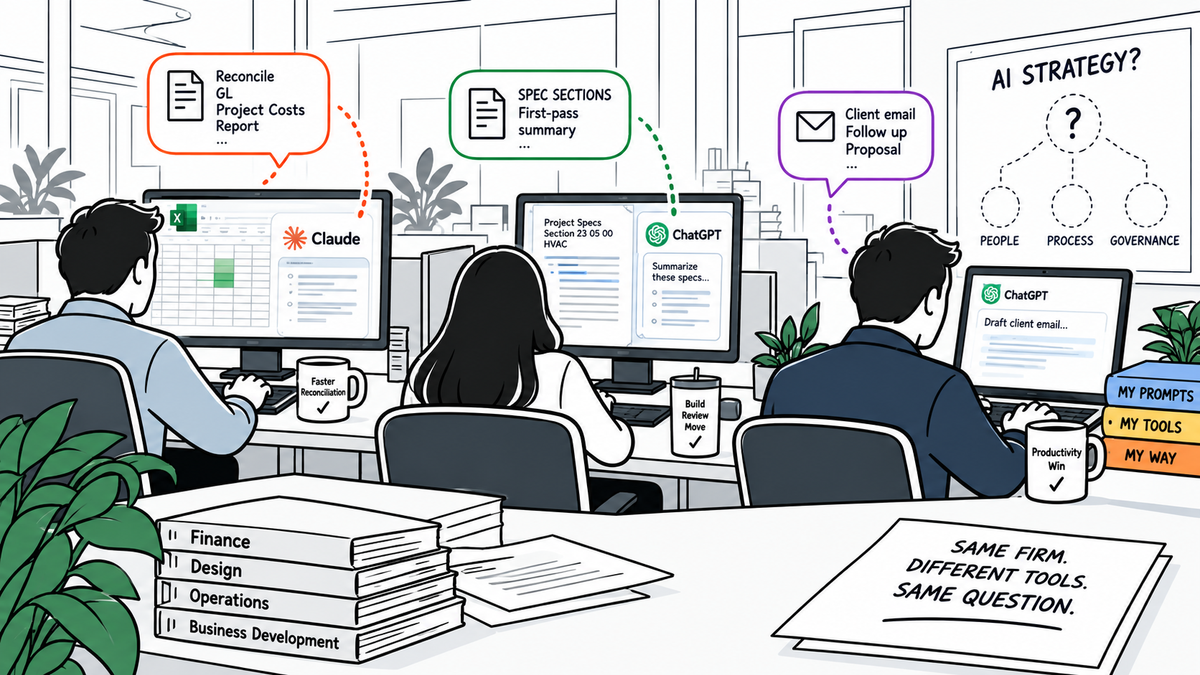
The controller built a reconciliation macro in Excel last spring and has since started feeding cell ranges into Claude. The PM on the hospital expansion pastes spec sections into a browser tab when she needs a first-pass summary. Somewhere down the hall, someone with a ChatGPT subscription is drafting client emails and calling it a productivity win. Three people at the same firm, none of them coordinating, all of them answering "yes" when someone asks whether the firm is using AI. Technically, they are right. In practice, the firm has a scatter pattern, and a scatter pattern is not a strategy.
This is worth naming clearly because the scatter pattern feels like progress from inside it. Tools are being used, hours are being saved at least some of the time, and nobody is complaining. But the firm has no idea which outputs it can trust, no way to know when the tool is quietly wrong, and no institutional memory of what the good prompts even were. When the person who figured something out leaves, the workflow leaves with her.
The question worth asking is not whether your firm is using AI. The question is where your firm sits on the capability spectrum, because that level determines what the next useful move actually is.
The Five Levels
AI capability in a professional services firm builds in stages, and the stages are not arbitrary. They map onto how trust gets established, how workflows become repeatable, and how the firm's institutional knowledge either gets preserved or quietly lost. The framework described here is drawn from Nate Jones' write-up, and it is useful precisely because most firms reading this are sitting somewhere between levels two and three, which is a specific and correctable position rather than a vague one.
Level one is curiosity without workflow. The firm has individuals who have tried AI tools on personal projects or low-stakes tasks: writing a draft email, summarizing a meeting transcript, generating a few options for a project name. These experiments live entirely outside firm systems, they are not repeatable by anyone else, and they produce no institutional learning. Level one is not nothing, but it is not organizational capability either. It is a hobby.
Level two is individual adoption. This is the scatter pattern described above. Several people in the firm have personal subscriptions or free-tier access to one or more AI tools, and each person has developed their own informal prompting habits. Some of them are getting real value. None of it is coordinated, documented, or governed, which means the firm is bearing reputational and data exposure risk it has not consciously accepted while capturing only a fraction of the benefit it could get if any of this were shared.
Level three is team-level workflow. A specific team or practice group has agreed on how to use AI for a specific task: RFP response drafting, spec review, meeting note formatting, invoice exception flagging. The prompts are written down somewhere, probably in a shared document that one person maintains. Outputs get reviewed before anything leaves the firm. This is the first level where the word "workflow" is accurate rather than aspirational, and it is also where the firm begins to learn what the tool actually does well versus what it confidently produces and gets wrong.
Level four is firm-level integration. The firm has embedded AI capability into the systems the whole firm runs on: the ERP, the PM platform, the CRM. Outputs feed into tracked processes rather than sitting in individual inboxes, there is a governance layer with some version of IT oversight and access controls, and the firm understands where its data goes when it leaves the building. According to figures aggregated by market analyst Nate B. Jones, enterprise-grade deployment of the same models that cost individuals $20 per month carries overhead that runs into thousands of dollars per seat when you factor in IT governance, data access controls, user training, and ongoing prompt maintenance. That gap reflects the actual infrastructure required to make AI outputs trustworthy inside a regulated workflow, not vendor pricing games.
Level five is augmented expertise. This is the level where AI is operating as a genuine amplifier of the firm's best practitioners, not a substitute for junior effort. Doug O'Laughlin of SemiAnalysis describes the honest version of this in a Latent Space podcast conversation: "I think of it as a junior analyst, right. The analyst goes and does all this really pain-in-the-ass information gathering and you bring it all together to make a good decision at the top." His point is that the meta-level judgment, the pattern recognition that comes from doing the work repeatedly and understanding why certain signals matter, still lives in the expert. The AI accelerates the gathering and the first-pass synthesis; the expert determines what it means and whether to trust it. A level-five firm has structured its workflows around that reality rather than around the assumption that the model can just run.
The Dark Factory Gap
The specific danger in this maturity ladder is not moving too slowly. It is skipping levels.
When a firm jumps from scattered individual use directly to automated outputs feeding real decisions, it creates what the source material calls the dark factory condition: automation running without the domain expertise in the loop to catch its mistakes. The outputs look correct, formatted correctly, referencing the right project numbers, using the right terminology, and nobody notices when they are wrong because the review step that would catch the error was removed in the name of efficiency.
A firm that has a reviewer checking AI-generated spec summaries before they go to the client has a level-three workflow. A firm that has automated those summaries into a client-facing report template where nobody is reading them carefully anymore has a dark factory problem dressed up as progress. The distinction is not about the technology; it is about whether the human judgment that makes the output trustworthy is still actually in the loop, or whether it has been quietly replaced by the assumption that the model is good enough.
Simon Willison's analysis of Claude Code's auto mode touches this from a different angle: confirmation fatigue, the phenomenon where asking humans to approve AI actions every few steps produces approval theater rather than actual review. People click through, and the oversight that was supposed to catch errors becomes a rubber stamp that creates the illusion of review without the substance. The same failure mode appears in services firms that have added an "AI output review" step to their workflow without training anyone on what to actually look for or giving them the time to find it.
What Level Are You?
Reading this, most people in AEC firms will land in one of three honest positions. The first is level two with aspirations: real individual adoption, no firm-level coordination, a vague plan to do something more structured later. The second is a messy level three, with one or two workflows that are genuinely repeatable, several more that depend entirely on one person who figured something out, and no clear picture of which category each use case falls into. The third is a genuine level three working toward four, with documented workflows, some governance thinking underway, and a specific blocker, usually IT capacity, data access, or budget authorization, sitting between here and the next step.
Knowing which one you are is the diagnostic move. Once you have placed yourself honestly, ask the people running your AI-adjacent workflows three things: whether the outputs are being reviewed before they affect a deliverable or a client, who owns the prompts and what happens to them if that person leaves, and whether the firm has made any deliberate decision about which tools it trusts for which purposes or whether trust has just accumulated by default. Those three questions will tell you more about your actual level than any vendor assessment will, and they will surface the specific gap worth closing rather than a generic recommendation to do more.

Member discussion: