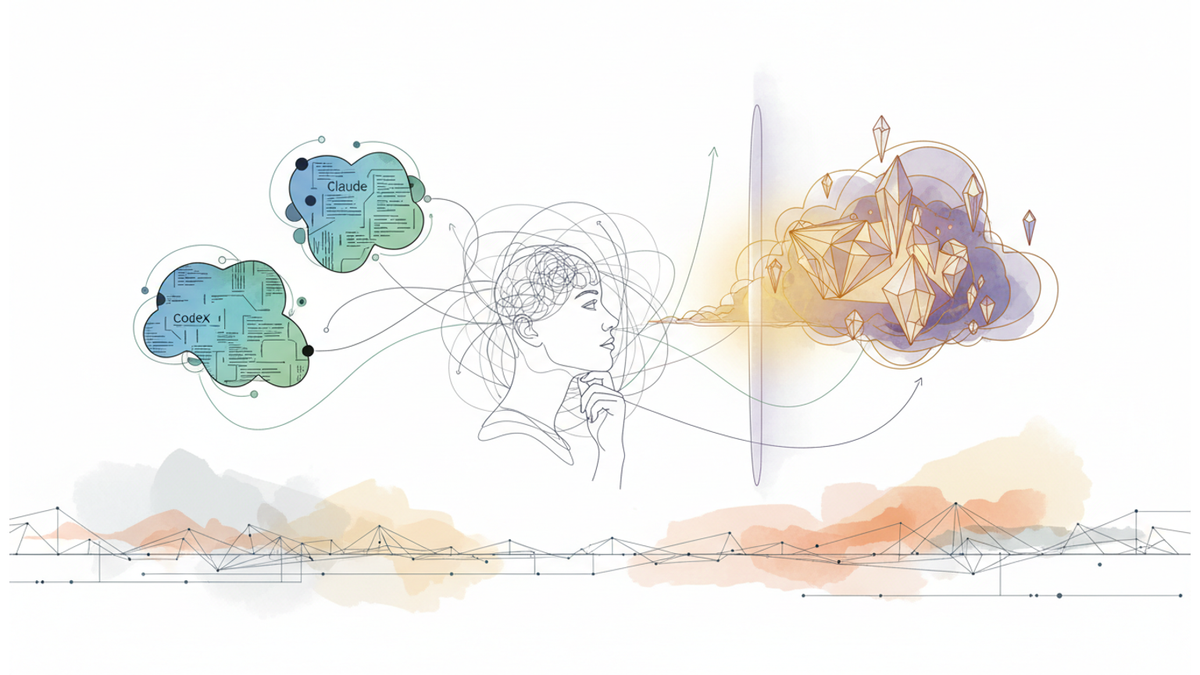
The tools are not competing with each other. They are differentiating, and knowing the difference is becoming a real professional skill, one that belongs to operations leads and principals as much as it belongs to developers. This week, four threads of coverage landed in a way that actually fit together, and the organizing insight across all of them is the same: firms that understand how these tools divide labor will operate them well, and firms that treat them as a bracket will keep picking wrong.
What this week produced, in order of decision relevance for a firm like Full Sail Partners doing internal development: a clear reframe of how Claude and Codex work as a team rather than a bracket; a name for the invisible coordination labor that grows every time you add an AI system; a new architectural concept for how fast classification and slow reasoning belong in different layers of the same pipeline; and the single most grounding production metric about what "agent-assisted" actually looks like at a team doing it seriously.
The Claude vs. Codex Question Your Team Is Probably Already Arguing
YouTube (NateBJones): Stop Picking Between Claude Code and Codex | Do This Instead lands the week's lead reframe cleanly: the question is not which tool is better, it is what each tool makes you better at doing with agents. The shorthand Nate Jones offers is worth holding onto: Claude makes steering agents feel natural, and Codex makes dispatching agents feel natural. Steering is what you do when you are in the cockpit, shaping a plan, deciding what done means, negotiating the scope of a task in real time. Dispatching is what you do when the plan is set and you are sending jobs into a queue to execute without needing to watch each one land.
The reason this matters for a firm building internal tooling is that the distinction maps directly onto roles and workflows that already exist in the firm. A project manager who needs to define the shape of a deliverable and adjust as it takes form is a steering problem. A developer who needs to run the same validation task across forty project records while working on something else is a dispatching problem. Buying one tool and trying to make it do both is not a failure of the tool; it is a failure to notice that the workflows are structurally different. Jones frames agent literacy as the professional skill of 2026, and the coding context is where these habits are showing up first precisely because code has a built-in proof of correctness: it either runs or it does not. Knowledge work is catching up fast, and the firms that develop these habits now will not have to unlearn the wrong ones later.
For a team primarily using Claude Code and Codex together, the immediate question to sit with is not which one to standardize on, but whether the work you are routing to each one is matched to what each one is actually good at. CLAUDE.md files, plan mode, and hooks are the instrumentation for the steering layer. Codex's queue architecture and auto-review loop are the instrumentation for the dispatching layer. Using them as a team rather than as alternatives is not a compromise position; it is the configuration that is actually doing serious work.
You Are Already the Integration Layer, and That Is the Problem
YouTube (NateBJones): I Was The Only Thing Connecting Claude, ChatGPT, and Codex. So I Built My Replacement. names something that anyone coordinating multiple AI systems will recognize immediately, even if they have not put language to it yet. When Claude, Codex, and any other AI tool you are running do not share state with each other, a human has to carry the context between them, which means reading the output of one system, reformatting it mentally or literally, and handing it to the next one as a prompt. Jones calls this the human-as-hallway problem, and the name earns its keep because it is accurate: you are not doing knowledge work at that point, you are doing routing.
The Open Engine architecture he describes as his solution is a queue-based coordination layer that lets different AI systems hand work to each other without a human standing in the corridor between them, carrying the briefcase. The Lindy/Flo Crivello example in the source is worth noting here: Crivello documented publicly that migrating his AI harness from one model to another required rewriting not the model call but the entire surrounding work system, which is exactly the point the next item develops in more depth. The token cost figures Jones mentions as "stories going around" are thin and should be treated as illustrative rather than benchmarked, but the labor cost of human coordination across multiple AI systems is a real line item that most firms are currently absorbing without naming it. Naming it is the first step toward doing anything about it.
For a firm at Full Sail Partners' stage of internal AI development, the practical takeaway is not necessarily to build an Open Engine equivalent right now, but to track how many hours per week someone on the team is spending as the hallway between AI systems. If that number is growing, it is a signal that coordination infrastructure has become the constraint, not model capability.
Model Switching Sounds Cheap. The Harness Rewrite Is Not.
YouTube (NateBJones): GLM 5.2 Is Free And Beats Claude On Most Work. So Why Can't Companies Switch? is the counterweight to every internal conversation about routing to the cheapest available model. GLM 5.2 is genuinely impressive on what Jones describes as the fat middle of everyday AI tasks: standard documents, familiar coding patterns, front-end work where the output is easy to inspect and the answer shape has been attempted millions of times. It is fast, cheap, and on that class of work, arguably the best option available. The case for using it on those tasks is real.
The trap the video identifies, and it is a precise observation, is that switching models is not a model decision. It is a work-system decision. The harness built around a frontier model, the prompt structure, the tool definitions, the output parsing, the error handling, the trust calibrations your team has developed over months of use, none of that travels with a model swap. What looks like a cost optimization is in practice a rebuild, and the rebuild cost has to be weighed against the per-token savings before the math makes sense. For a firm that has not yet stabilized its AI harness, this is actually reassuring news: get the harness right first, because the model landscape will keep changing and a stable harness is what makes model switching a real option rather than a project in disguise. Open-source is not a drop-in swap. It is a destination you can reach once the surrounding work system is solid enough to relocate.
Fast Cheap Classification Nodes Are About to Show Up in Every Architecture Conversation
The Jev coverage from two sources (YouTube: Jev by Typespace overview and YouTube: Jev by Type-Safe AI review) introduces an architectural concept that is worth understanding now, before the vendor conversations start, because it will appear in every serious internal AI build discussion in the next twelve months. Jev is a model from Typespace, co-founded by a ChatGPT co-founder, that does not generate text. It returns structured decisions: classifications, scores, yes/no probabilities. It evaluates multiple questions in parallel rather than sequentially, which means it is operating on a fundamentally different compute path than an autoregressive language model.
The System 1 / System 2 framing the sources use is a useful shorthand: Jev is designed to be the fast, cheap intuitive layer in an agentic pipeline, handling the decision nodes where you need a quick reliable classification (is this ticket urgent? does this email require a response? which model should handle this task?) while a slower reasoning model handles the work that actually requires extended thought. Vercel reportedly replaced a Gemini 2.5 Flash classifier with Jev and saw a 6x speed improvement with performance that saturated their evaluation benchmark, though these figures come from the source coverage of vendor claims rather than independent benchmarks, and the Vercel attribution is one step removed. The broader architectural point holds regardless of the specific numbers: routing and classification at the decision layer are genuinely different workloads than generation, and treating them as the same problem with the same tool is expensive in both cost and latency. For a firm building internal tooling the relevant question is not whether to use Jev specifically, but whether any of the decision nodes in your planned pipeline are currently being handled by a full reasoning model when a classification call would do the job at a fraction of the cost.
Local-First and VM-Based Is Not a Hobbyist Position
Latent Space: Why Anthropic Thinks AI Should Have Its Own Computer, with Felix Rieseberg of Claude Cowork and Claude Code Desktop grounds an important architectural debate in practitioner terms. Felix Rieseberg's argument at Anthropic is that putting Claude where you actually work, on your local machine, inside a virtual machine that gives it a sandboxed environment to install tools and run scripts, is more powerful than connecting it to a remote API, because the agent can act more independently without requiring approval for every command. The VM is both a safety boundary and a capability unlock: Claude gets a computer of its own, can behave like an operator rather than a query, and does so without having unstructured access to your production environment.
The detail worth sitting with for an internal development team is that Cowork wrote itself: a team of humans orchestrating multiple Claude Code instances built the tool in roughly ten days. That is a concrete illustration of the execution-cost shift Felix describes, where the expense of building multiple candidates and choosing based on reality has dropped enough that you do not have to commit to a design before building it. For a firm deciding whether to invest in local-first agent infrastructure versus a SaaS wrapper, the question is whether the work your agents will be doing requires the kind of environmental access that a VM enables, or whether a managed cloud interface is sufficient for the actual task list you have. The answer is probably different for your development team and your operations team, and it is worth being explicit about which one you are solving for.
Sixty-Five Percent of PRs Is the Most Grounding Number of the Week
Simon Willison: A Fireside Chat with Cat and Thariq from the Claude Code team contains the production metric that puts everything else in this roundup in proportion. Claude Tag, Anthropic's Slack integration for collaborative agent work, now lands 65 percent of the product engineering pull requests for the Claude Code team itself, a team that has been running agent-assisted development longer and more seriously than almost any other. That is a ceiling, not a floor: it is what sustained, committed, expert use of agent-assisted development looks like at a team with every advantage, and it still means 35 percent of PRs are written by humans. The framing that agents are replacing engineering work is precisely wrong; the accurate framing is that a team doing this well has learned to delegate a significant portion of implementation work to agents while directing more of their attention toward what done should look like in the first place.
The additional detail that Anthropic's Claude Code system prompt recently shrank by 80 percent, because explicit instruction lists now reduce quality on the latest models, is the kind of operational signal that a team actively tuning their agent setup should track. The best practice from six months ago is already counterproductive. This is not a reason to avoid the work; it is a reason to build the habit of reviewing your agent instructions on the same cadence you review your pipelines, rather than treating them as set-and-forget configuration.
The pattern across this week is not about which tool is winning. It is about the moment when the cost of not having a coordination strategy becomes a visible line item: in the hours someone spends carrying context between AI systems that do not talk to each other, in the token cost of running a full reasoning model on a task that a classifier could handle, in the rebuild cost hiding inside what looked like a model swap. Every item this week is a different angle on the same underlying question, which is not "which AI should we use" but "how do we build a work system around AI that we can actually operate." That question has an answer, and firms that start working toward it now will have a meaningful head start.
Member discussion: