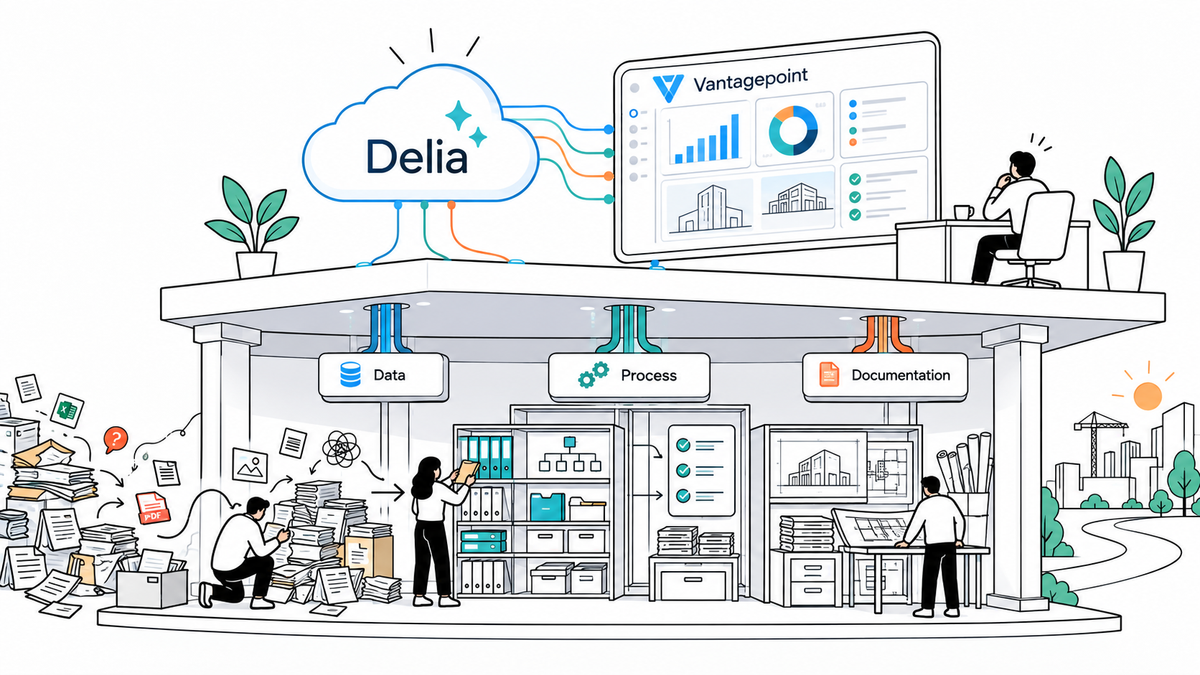
Delia is here. It is cloud-first, embedded in Vantagepoint, and the pitch is exactly what you would expect: AI built for AEC firms, trained on Vantagepoint data, no third-party integration required. For principals who have been fielding AI vendor calls for two years without knowing what to do with them, this feels like relief. One vendor, one platform, one answer.
The narrower version of that claim is buried beneath the deck. Delia looks good and can be a capable tool for the tasks it is designed to handle, but no embedded AI feature has ever fixed a firm whose project data lives in fourteen different formats, whose timesheet compliance runs at 60 percent, and whose billing workflow is documented in one project manager's head. The model is not the constraint, and it never was.
The Reality of Readiness
A 2025 McKinsey State of AI report found that 88 percent of organizations use AI in at least one business area, but only about 6 percent see meaningful payoff from it. A 2025 Harvard Business Review study found that only about 7 percent of enterprises said their data was fully ready for AI, with nearly three-quarters reporting difficulty preparing it. Those two numbers belong next to each other, because they tell the same story: adoption is easy, readiness is hard, and most organizations are doing the first thing while avoiding the second.
AEC firms are not exempt from this pattern. If anything, the project-based billing model makes it worse, because data quality problems are not uniformly distributed across the firm. They cluster at the project level, which means a firm can have clean aggregate financials and genuinely chaotic job cost records at the same time, and AI has no way to tell the difference. It will generate outputs from whatever it is given, and those outputs will look authoritative. That is precisely the risk.
What Readiness Actually Means
Process standardization and data legibility are the binding constraints on whether AI delivers value, not model quality. This is not a controversial claim anymore, though it still gets treated like one in rooms where a vendor has just finished a demo. In practice, readiness means being able to answer a short list of uncomfortable questions before the system goes live.
Are your project codes applied consistently, or does every PM maintain a personal taxonomy? Do your phase and task structures reflect how work actually gets done, or how everything was configured in year one and never revisited? Is your timesheet data complete enough that a model trained on it would learn your real labor patterns, or would it learn your approval lag instead? These are not technology questions. They are operations questions, and the technology cannot answer them for you.
The firms that extract value from embedded AI are almost always the firms that already cleaned this up for other reasons, because they grew tired of reconciling by hand, or because a new operations manager insisted on it, or because they grew fast enough that informal systems simply broke. The AI did not motivate the cleanup. The cleanup made the AI possible.
Five Practices Worth Doing Now
Standardize your project structure where possible and document it. Phases, tasks, and cost codes need to mean the same thing across every project in the system, not just the ones set up by careful PMs. If your structure varies by project type, document that variation explicitly and enforce it. AI that trains on inconsistent structure will produce inconsistent outputs, and you will have no clean way to know which ones to trust.
Audit your data before you automate it. A 2025 Harvard Business Review study found that nearly three-quarters of enterprises reported difficulty preparing their data for AI. The path forward is not sophisticated: pull a sample of your active projects, check timesheet completeness, check phase alignment, and check whether the financial data matches the work-in-progress schedule. Find the gaps before a model finds them for you in a forecast.
Write down how your business actually runs. This sounds patronizing until you try to do it. Most firms have undocumented tribal knowledge concentrated inside the same three people who have been there longest, and AI cannot read the room the way those people can. Document your billing workflow, your project setup checklist, and your labor rate assumptions along with where they live. These documents are useful on their own, and they become the reference layer that makes AI outputs interpretable.
Scope your first AI use case narrowly. The 90-day rollout framework worth studying starts with clarity and guardrails, runs a controlled pilot against a single high-impact use case, and measures before scaling. That sequencing is not arbitrary. Broad AI rollouts in organizations with messy data produce broad AI confusion, which is harder to diagnose and correct than a narrow failure in a contained pilot. Pick the one thing, prove it, and move from there. This is where Delia will help - Deltek is providing a guided tour to areas that they as the software publisher know best how to leverage.
The Order Matters More Than the Speed
Research cited in a three-question AI framework puts the correct rollout sequence as personal productivity first, then workflow augmentation, then process redesign, then strategic capability. Only 21 percent of organizations in the McKinsey research had fundamentally redesigned any workflow around AI, yet process redesign was the single attribute most correlated with actual value creation. Most firms are stuck in the personal productivity layer because that is the easiest layer to demonstrate and the hardest to scale without the foundational work underneath it.
Delia is exciting. Deltek has genuine context on how AEC firms operate, and embedded AI that understands Vantagepoint's data model is a real advantage over a generic tool. The firms that will get value from it in the first year, though, are the ones doing boring, foundational work right now, not because they knew Delia was coming, but because solid data and documented processes are useful regardless of what tool is sitting on top of them.
Where to Start the Conversation
The five practices above are not a sequential checklist so much as a diagnostic: start with the one that your firm would score worst on, because that is almost certainly the constraint.
If you are a Vantagepoint user thinking through what Delia's arrival means for your firm, a few questions are worth sitting with before your next planning conversation. Where does your project data quality break down, and does your team know it? Who owns the documentation of your billing workflow, and when was it last updated? Have you identified the one use case where AI output would be most immediately testable against something you already know to be true? And when you imagine a new AI feature generating a forecast or a report, who in your firm has the context to know whether to trust it?
That last question is the one most firms skip. Where you are starting, and what does the friction point looks like from where you sit? Drop it in the comments - The patterns are worth comparing, and this is the kind of problem where other people's specific experience is more useful than general advice.

Member discussion: