The Instructions Working Against You
There is a reasonable chance your CLAUDE.md file still contains lines like "IMPORTANT! Never do this!" or detailed reminders about which stack the project uses, where to find the entry point, or what framework handles routing. Those instructions made sense when you wrote them. The model at the time needed the scaffolding, and the alternative was watching it wander around the codebase trying to orient itself.
The problem is that the models have moved considerably since those instructions went in, and what was helpful scaffolding for an earlier model is now noise that actively works against you. As Anthropic's Claude Code team explains, today's models are substantially better at understanding your intent and reading your codebase directly, which means that extra context in CLAUDE.md now competes with the instructions that actually matter, produces more tool calls than necessary, and leads to worse results overall. The file should only contain what Claude genuinely cannot see from the code itself: a service that still pulls from a legacy source not referenced anywhere in the codebase, an environment-specific behavior that is invisible to static analysis, a constraint that lives only in someone's head. Everything else should come out.
Auditing your CLAUDE.md against the current model by reviewing each line and asking whether the model can already infer it from the codebase is one of the faster ways to recover quality that has been quietly degrading without an obvious cause.
Auto Mode Is Not the Same Thing as a Guarantee
Switching from manual approval to auto mode is the right call for most sessions, and the numbers make a reasonable case for it: in a study Anthropic published in August, auto mode blocked 89% of clearly dangerous commands, compared to only 14% caught by humans approving manually. The practical implication is that the average person reviewing commands in a fast-moving session is catching far less than they think they are, and auto mode catches far more.
What auto mode does not do is provide a guarantee. Roughly one in ten of those dangerous commands still passed through in that study, which is an acceptable rate for many situations and an unacceptable rate for some. The important architectural point is that if you need a guarantee, the only place to get one is in the harness, not in the model's judgment. Specifically: deny rules are evaluated before the auto mode classifier even looks at a tool call. If a tool call matches a deny rule in your project configuration, the classifier never sees it. That is the only mechanism that actually prevents Claude from taking a specific action rather than merely making it unlikely.
The practical question for calibrating your deny rules is simpler than it sounds. If Claude gets something wrong, can you take it back? Wrong code can be reverted, so you can leave that to the model's judgment. An action that cannot be undone, or that touches something outside the codebase boundary, deserves a deny rule. The classifier is not the last line of defense for things in the second category.
The Credential Problem That Runs Locally
Running Claude Code locally against your actual development environment means that any secret or credential present on that machine is potentially reachable, not necessarily by Claude directly, but by shell commands and their child processes once they are running. Permissions control whether a tool call executes; they do not constrain what that tool call or its subprocesses can reach once it is running. This is a meaningful distinction when sessions are running for hours without active supervision.
Cloud sessions solve this by running in remote, ephemeral machines where secrets not committed to git are simply absent from the environment. There is nothing to reach because there is nothing there. For long-running or parallel sessions especially, this is worth the configuration overhead, because the alternative is relying on a permission model to constrain behavior that happens below the permission layer.
Sandboxing shell commands at the OS level provides a related boundary for local environments, addressing the same gap between what permissions control and what subprocesses can actually do.
Hooks That Actually Send Claude Back
Hooks are where automated verification lives, and they are worth getting right because a common configuration mistake quietly undermines the whole point. When a check fails and you want Claude to return to fix it rather than proceed, the hook needs to exit with code two, not code one. A one-exit code marks the task complete regardless of the failure. A two-exit code is the signal that sends Claude back into the work. This is documented behavior and not a subtle edge case, but it is easy to get wrong if you are configuring hooks quickly and moving on.
The broader principle here is that your CI pipeline and your hooks together now carry the verification work that you used to do by watching the session. When you are running dozens of sessions simultaneously, you are not reading the output of each one carefully as it happens. What catches problems is the automated layer, so getting that layer right is worth more time than it probably got when you first set it up.
How the Scale Numbers Change the Job
Anthropic's internal usage went from roughly 2,500 code changes per day in May to more than 30,000 per day in September, driven by running dozens of parallel Claude Code sessions rather than by any single session getting dramatically faster. That number is worth sitting with for a moment, because it describes a different kind of work than most developers are currently set up to do.
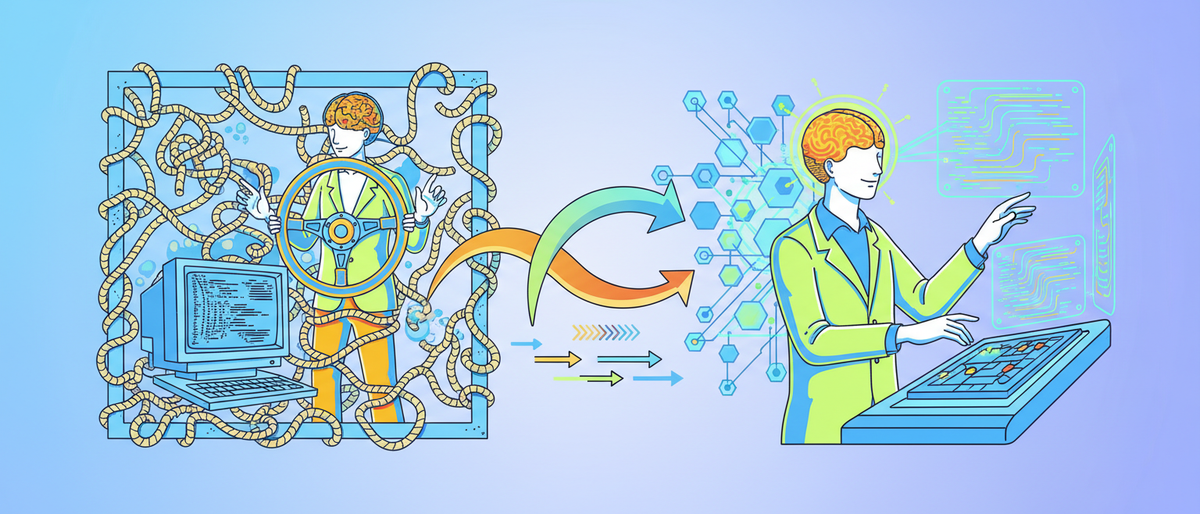
The transition it describes is from steering to managing. Steering means you are in the session: approving commands, redirecting when something goes sideways, watching the output develop and intervening when the direction is wrong. Managing means you configure the environment carefully before the session starts, the session runs for hours without your active attention, and what you review is what comes out. Almost everything that happened in between was handled by the model, the harness, or the environment you built.
This does not mean you are less involved. It means your involvement has moved. The judgment calls you used to make mid-session are now expressed as CLAUDE.md content, deny rules, hook configurations, and environment setup. Getting those things right requires more thought upfront than approving a command in the moment, but it scales to dozens of sessions simultaneously in a way that command-by-command approval does not.
Orchestrated Sessions and What They Require
Claude Code Projects, currently in beta, enables an orchestrator model to spawn and manage sub-sessions automatically, handling context management without manual compaction. The practical shape of this is a Fable session acting as the orchestrator, coordinating Opus 5 sub-sessions that do the actual work, with the orchestrator handling the context boundaries that you would otherwise manage manually. Context management, which has been one of the persistent friction points in longer sessions, moves into the orchestration layer rather than sitting as a manual task between sessions.
This is where the trajectory of these practices is pointing: not toward a single longer session but toward sessions that manage other sessions, with the developer's judgment expressed in configuration rather than in real-time approval. The orchestration approach is not yet standard practice for most teams, but understanding how it works now is what makes it possible to build toward it deliberately rather than arriving there by accident.
What to Do Differently Starting Monday
Take one task that is meaningfully larger than what you would normally hand to Claude, and run it. Not dramatically larger, just one level above your current comfort ceiling. Before you start, verify that your CI actually catches the specific things you care about, because if it does not, you have no feedback layer when something goes wrong in an unsupervised session. Then spend time on environment configuration: network access, secrets, setup scripts, and what should be a deny rule versus what can be left to the model's judgment.
Audit your CLAUDE.md by reviewing each line against what the model can already infer from the codebase and removing what is redundant. Audit your hooks and confirm they exit with code two for failures you want Claude to fix rather than bypass. If you are running locally, consider what credential exposure actually exists in your environment and whether a cloud session makes sense for the work you are doing.
Then watch where the session gets stuck. That specific point, the place where Claude still needs something it does not have, is the signal for what to configure next.
Member discussion: